Paying too much for CarGurus leads? What else independent dealers can try
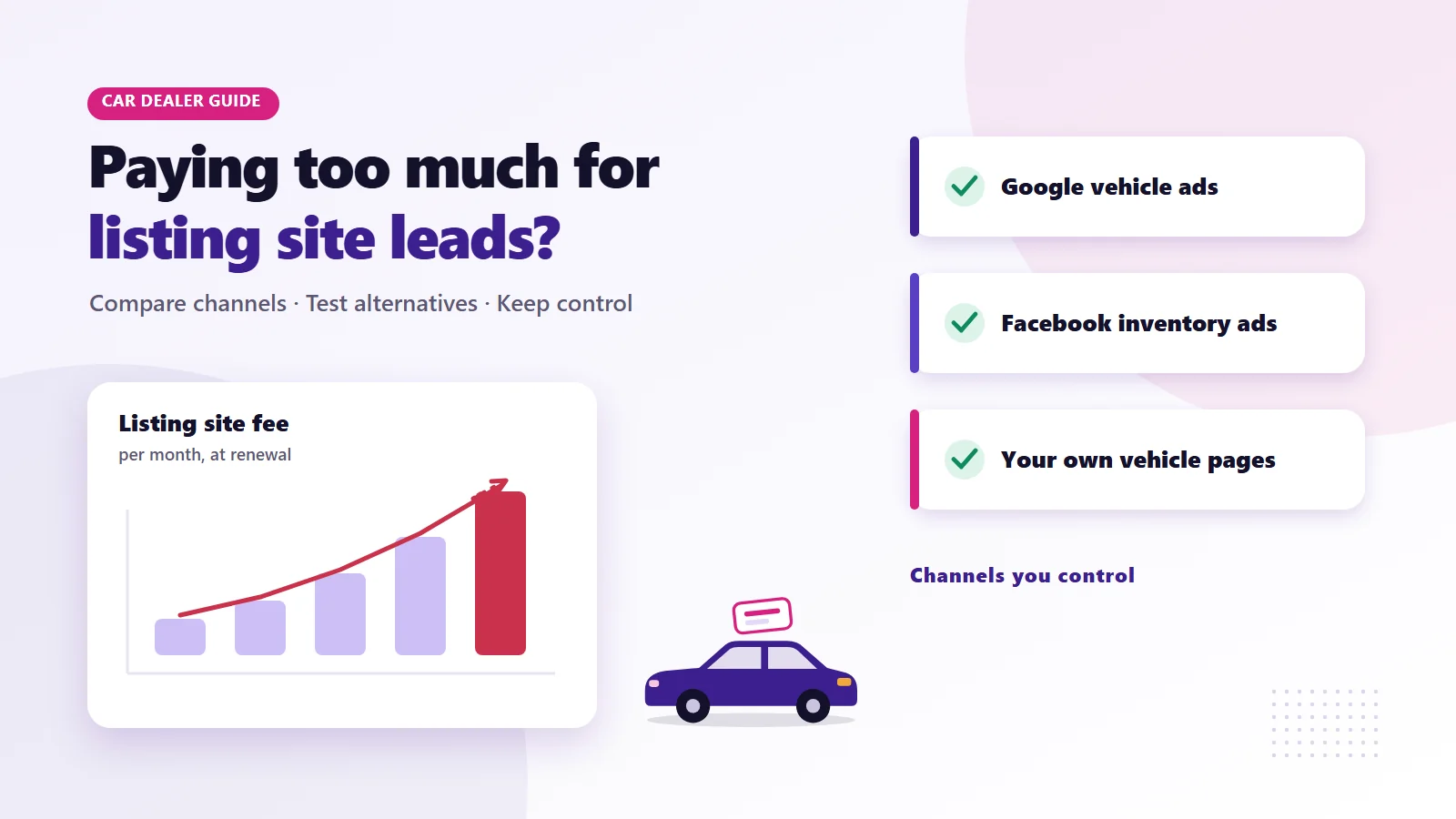
Listing fees keep climbing, and one site controls too many of your leads. Here is how an independent lot compares channels fairly and tests alternatives without risking monthly sales.
SocialPulse Hub team · Updated 31 Oct 2026 · 12 min read
Key takeaways
- Listing sites rent you an audience. CarGurus' own figures show the average US dealer paid 8% more in Q2 2026 than a year earlier, so relying on one site hands it control of your margins.
- Compare every channel on cost per car sold, not cost per lead. You need reliable lead source tracking first.
- Google vehicle ads, Facebook inventory ads, Marketplace, your own vehicle pages and past customers are all channels you can control.
- Run alternatives alongside your listing sites for about 12 weeks, then decide with your own numbers.
If your CarGurus renewal made you wince, the company's own numbers explain why. In its second quarter 2026 results, CarGurus reported that the average US dealer paid it $8,134 for the quarter, roughly $2,700 a month, which is 8% more than a year earlier. Over the same period its number of US paying dealers grew by only 3%, to 26,151.
That is an average across every dealer on the platform, from single lots to large groups, so your own bill may be higher or lower. The direction is the point: the typical dealer is paying more each year for the same marketplace.
This is not a guide that tells you to cancel CarGurus tomorrow. For many lots it still sends real buyers. The point is that when one listing site controls most of your leads, it also controls your margins. This guide looks at CarGurus alternatives an independent dealer can actually run, how to compare them fairly, and how to test them without putting your monthly sales at risk.
It is written for independent car dealers in the US with roughly 20 to 200 cars, a small team and no big-group marketing budget. Much of it applies to UK forecourts too, with AutoTrader in place of CarGurus.
Why listing site costs keep climbing
Listing sites like CarGurus, Cars.com and Autotrader are marketplaces. You are renting space in front of their audience. That has real advantages: shoppers are already there, and you do not need to build traffic yourself. It also has a few built-in problems for an independent dealer.
- You compete side by side with every other lot. Your car sits next to similar cars from dealers across your area, sorted and rated mainly on price.
- Price is the first thing shoppers compare. When cars are sorted and rated against similar listings, a well-reconditioned car priced to make gross can look less attractive than a cheaper one down the road.
- There is no public price list. Packages are quoted dealer by dealer, which makes it hard to know whether your renewal is fair.
- The audience is not yours. When you stop paying, the leads stop. Nothing you spent builds a lasting asset for your business.
None of this makes listing sites bad. It means they work best as one channel among several, not the only one.
Step 1: Work out your real cost per car sold
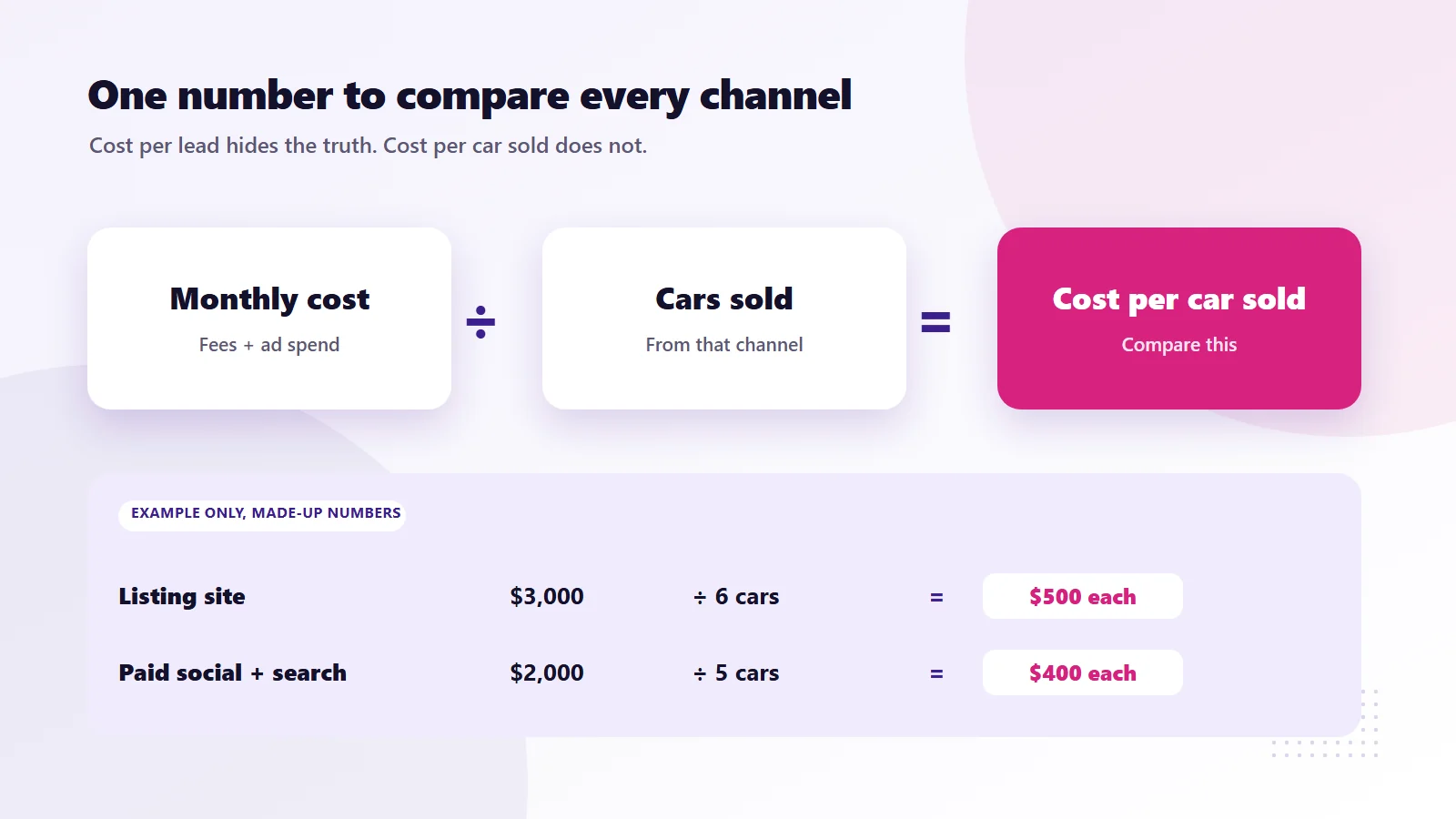
Before you compare anything, you need one number that cuts through the dashboards: what each channel costs you per car actually sold. Cost per lead is useful, but a cheap lead that never answers the phone is not cheap.
| What to collect for each channel | Where it comes from |
|---|---|
| Monthly cost (subscription, ad spend, fees) | Invoices and ad accounts |
| Leads (calls, forms, chats, texts) | The channel dashboard plus your CRM |
| Appointments set | Your CRM or sales log |
| Cars sold | Your deal jackets or DMS, matched to lead source |
| Front-end gross on those cars | Your DMS |
Then the two numbers that matter:
- Cost per car sold = monthly cost divided by cars sold from that channel
- Gross after marketing = front-end gross on those cars minus the channel cost
Here is a simple example, with made-up numbers purely to show the maths:
| Example only | Listing site | Paid social and search |
|---|---|---|
| Monthly cost | $3,000 | $2,000 |
| Leads | 60 | 45 |
| Cars sold | 6 | 5 |
| Cost per car sold | $500 | $400 |
The point is not which column wins in this example. It is that you cannot make a sensible decision about your CarGurus renewal until you know these numbers for your own lot. If your CRM does not record lead source reliably, fix that first. Even a shared spreadsheet where salespeople note "where did they find us" for every deal is better than guessing.
CarGurus vs Autotrader vs Cars.com: how they compare
Shoppers search "CarGurus vs Autotrader" and "CarGurus vs Cars.com" all the time. Dealers should ask the same question, from the other side of the counter.
| CarGurus | Autotrader | Cars.com | |
|---|---|---|---|
| How dealers pay | Subscription packages. US average $8,134 a quarter in Q2 2026, up 8% in a year (company figure) | Subscription packages, quoted per dealer | Subscription packages, quoted per dealer |
| Strength | Very large shopper audience, strong price transparency | Long-established brand, wide reach | Strong research traffic and dealer reviews |
| Watch out for | Paying for leads on cars priced to win the rating, not to make gross | Package creep as you add features | Price rises justified by your own low cost per lead |
Published price lists are rare, so always get a written quote and compare it against your own cost per car sold. The right answer for most independents is not one site or another. It is a mix where no single channel can raise your costs without you having somewhere else to go.
How to get more leads for car sales from channels you control
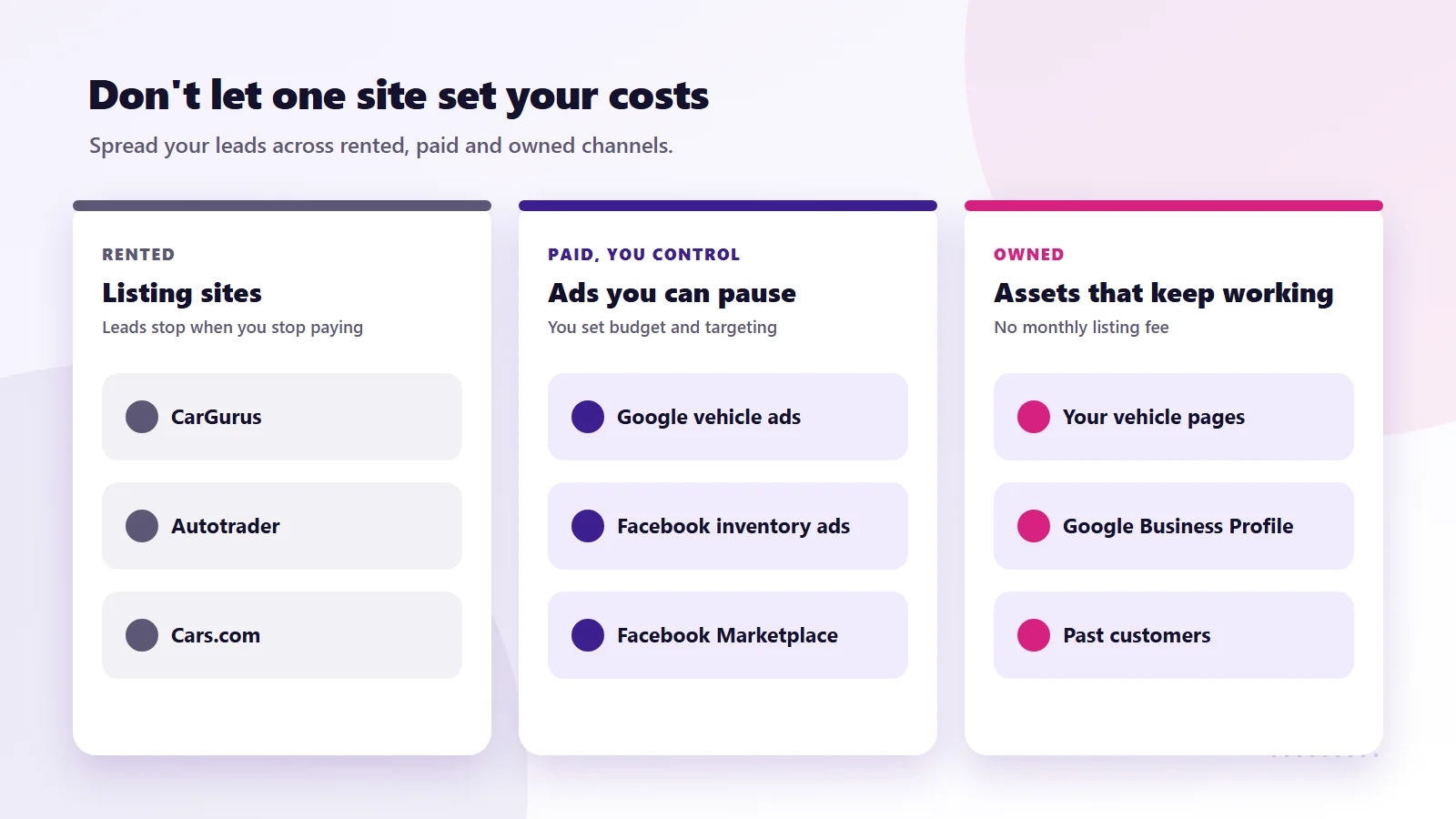
The options below fall into two groups. Paid channels you control, where you set the budget and can pause at any time. And owned channels, which keep working for you without a monthly listing fee.
1. Google vehicle ads
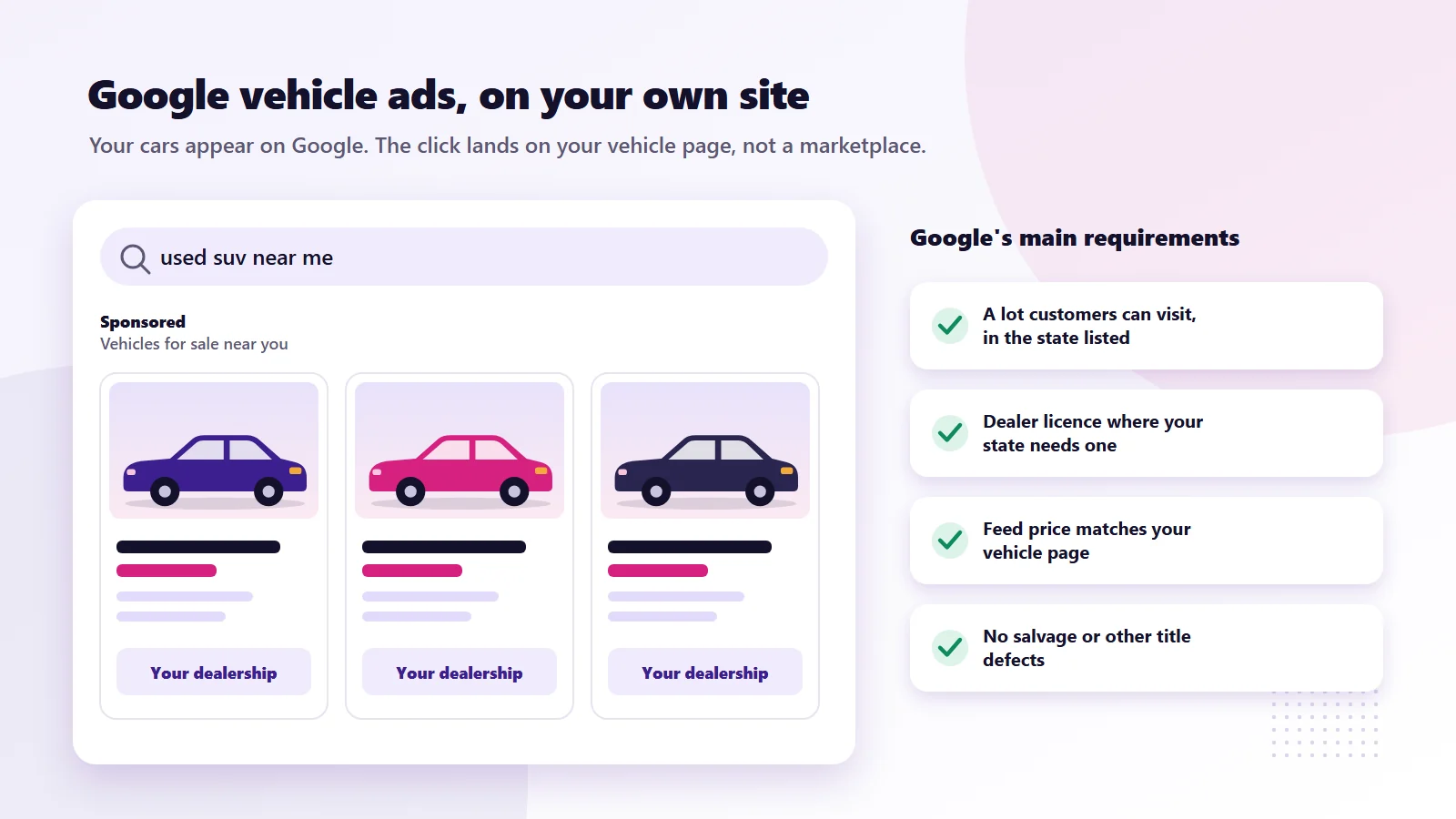
Google vehicle ads show your actual cars, with photo, price and mileage, at the top of Google when someone searches for a model near them. According to Google's vehicle ads overview, the format is fully released in the US, and you switch it on as an add-on in Google Merchant Center.
The main requirements from Google's vehicle ads policies:
- A physical location where customers can see and buy the car, in the state where it is listed
- A valid dealership licence where your state requires one
- A price in your feed that matches the price on your vehicle page exactly
- No title defects, so salvage and similar titles are not eligible
You need a vehicle feed, which many dealer website providers can produce, and a Google Ads campaign such as Performance Max that uses it. The big difference from a listing site is that the click lands on your own website, and the shopper sees only your cars on that page.
2. Facebook and Instagram inventory ads
Meta's automotive inventory ads work in a similar way on Facebook and Instagram. They build ads from your stock list and show each shopper the cars they are most likely to want. Google catches people who are already searching. Facebook reaches people in your area who are in the market but have not started searching listing sites yet, and brings back people who looked at your cars and left.
We have written a full step-by-step guide on how to set up Facebook inventory ads for a used car lot, covering the feed, the catalogue, the pixel and the campaign.
3. Facebook Marketplace
Marketplace is where a lot of local used car shopping now starts. Dealer listings usually come through approved listing partners rather than being posted one by one, and Meta's vehicle catalogue reference sets stricter rules for Marketplace, such as more than 500 miles on the clock and at least two photos. Ask your website or inventory provider whether they can feed your stock to Marketplace.
4. Your own website and vehicle pages
Every channel above sends people to your vehicle detail pages, so those pages have to earn their keep. A shopper who lands from Google or Facebook should see, on a phone, within a few seconds:
- Clear photos, starting with a good front three-quarter shot
- The price, mileage and key features without hunting
- One obvious way to get in touch: call, text, chat or a short form
- Trust signals, such as reviews, warranty information and your address
Slow, cluttered vehicle pages quietly waste every dollar you spend driving traffic to them. Improving them helps your listing site leads too, because many shoppers visit your website before they call.
5. Google Business Profile and reviews
When someone searches "used cars near me" or your dealership name, your Google Business Profile is often the first thing they see. Keep hours, photos and contact details current, reply to reviews, and ask every happy buyer for one. It costs nothing but time, and it supports every other channel on this list.
6. Your past customers
The cheapest lead is someone who already bought from you. A simple routine of service reminders, trade-in check-ins and "we just got a car you might like" messages to past buyers can produce repeat and referral business that no listing site charges you for. Make sure you have their consent to contact them.
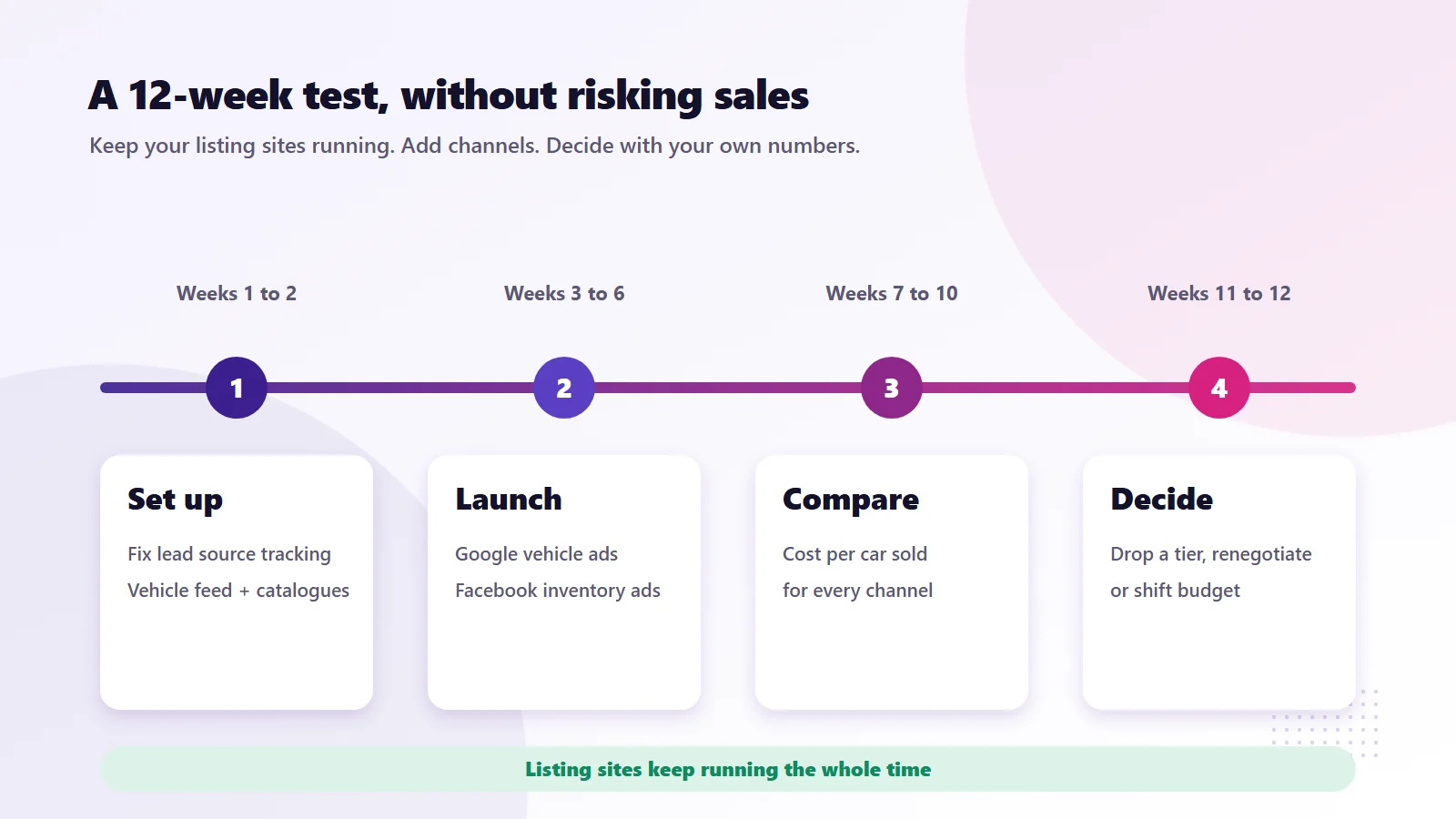
Step 2: Test alternatives without risking your sales
The safest way to reduce your dependence on CarGurus is not to cancel it. Run alternatives alongside it, measure for long enough to trust the numbers, then decide.
| Weeks | What to do |
|---|---|
| 1 to 2 | Fix lead source tracking in your CRM. Set up your vehicle feed, Google Merchant Center and Meta catalogue |
| 3 to 6 | Launch Google vehicle ads and Facebook inventory ads with a modest budget. Keep listing sites running as normal |
| 7 to 10 | Compare cost per car sold across every channel using your own data |
| 11 to 12 | Decide. You might drop a listing site tier, renegotiate with real numbers in hand, or shift budget where it sells more cars |
A few weeks of data from your own lot beats any industry average. It also gives you leverage. Walking into a renewal conversation knowing your cost per car sold from three channels is very different from walking in with no alternative.
Common mistakes when moving away from listing sites
- Cancelling before the replacement is proven. Leads drop, sales drop, and the experiment gets blamed.
- Sending ad traffic to the homepage. Every vehicle ad should land on that car's own page.
- Letting feeds go stale. Google requires the feed price to match your page. Sold cars and old prices in a feed waste money and break trust.
- Judging channels on cost per lead alone. Count cars sold and gross, not form fills.
- Slow follow-up. Leads from your own ads go cold just as fast as listing site leads. Answer within minutes, not hours.
- No one owns it. Someone on the team has to check the numbers every week, even if an agency runs the ads.
How this has worked for us
Across the dealership accounts we have worked on, Meta campaigns built on this kind of setup have brought in more than 1,100 leads. Every lot is different, and results depend on your stock, pricing, area, photos and how quickly your team responds. What stays the same is the approach: track properly, test alongside what already works, and let your own numbers decide.
If you want help putting this together, see how we run Meta Ads for dealerships and Google Ads campaigns, or request a free audit and report using the button below.
Frequently asked questions
What are the best CarGurus alternatives for independent dealers?
The main options are other listing sites such as Autotrader and Cars.com, plus channels you control: Google vehicle ads, Facebook and Instagram inventory ads, Facebook Marketplace through a listing partner, your own website and Google Business Profile, and marketing to past customers. Most independents do best with a mix rather than a single replacement.
How much does CarGurus cost for dealers?
CarGurus does not publish a public price list. In its second quarter 2026 results, it reported that the average US paying dealer paid $8,134 for the quarter, roughly $2,700 a month, up 8% on a year earlier. That is an average across all dealer sizes, so your quote may differ. Always get a written quote and compare it with your own cost per car sold.
CarGurus vs Autotrader: which is better for dealers?
It depends on your market and stock. Both charge mainly through subscription packages quoted per dealer. Run both against the same measure, cost per car sold, and keep the one that sells cars more profitably for your lot.
CarGurus vs Cars.com: which brings better leads?
Lead quality varies by area and price point. Track appointments and cars sold by source in your CRM for a few months. That tells you more than any national comparison.
What do Google vehicle ads need?
In the US, you enable the vehicle ads add-on in Google Merchant Center, provide a vehicle feed and run a Google Ads campaign that uses it. Google requires a physical location in the state where the car is listed, a dealership licence where required, a feed price that matches your vehicle page, and no title defects such as salvage.
Should I cancel CarGurus?
Not before you have an alternative that is proven on your own lot. Run new channels alongside your listing sites, compare cost per car sold for around 12 weeks, then decide whether to drop a tier, renegotiate or cancel.
How do I get more leads for car sales without listing sites?
Use channels that send shoppers to your own website: Google vehicle ads, Facebook inventory ads, Marketplace through a partner, a strong Google Business Profile and regular contact with past customers. Make sure your vehicle pages load fast on a phone and make it easy to call, text or chat.
Have a question about this guide or your own setup? Contact us and our team will get back to you.